

The closing stages of the Second World War ushered in a new age. The Germans had rained down V2 missiles on allied cities and the USA had made history with the first ever operational use of nuclear weapons, against the Empire of Japan. Sir Winston Churchill, in a letter to President Truman in May of 1945, said of Russia, ‘An iron curtain is drawn down upon their front. We do not know what is going on behind…’.
The conflict had significantly redrawn the world’s political boundaries, particularly in Europe, with Germany and Poland having major border changes and Italy ceding territory. The war had also led to the collapse of empires, enabling the independence of former colonies and the rise of the United States and the Soviet Union as the dominant global powers, which in turn created new geopolitical divisions.
Against this backdrop, the world entered a new and dangerous period of its history. The Cold War. A war fought on many fronts and even in actual wars ‘by proxy’ but without direct conflict between the two ‘superpowers’.
The US had demonstrated a minor interest in guided missiles during World War Two and in 1947 had funded a research project (MX-774) into ballistic missiles. This was cancelled during sharp budget cutbacks but nonetheless yielded some excellent data for future use. In 1950 a study contract was awarded to Convair, the contractor for the cancelled MX-774, to determine the best type of long-range missile, glide or ballistic. The study was named MX-1593. In September 1951 Convair reported back with the findings of the study to say both were feasible; the ballistic version, now called Atlas, being favoured by the USAF.
A 1951 intelligence estimate, from the CIA, made sobering reading. It stated a belief that there was a desire by the USSR to dominate a communist world. Furthermore, it predicted that armed conflict between the USSR and the USA (and its allies) was eventually inevitable. Subsequent intelligence estimates became still gloomier.
The Soviet Union detonated its first atomic fission device on 29 August 1949, some years ahead of intelligence estimates. Four years later, on 12 August 1953, the first Soviet thermonuclear test, a Lithium-6 Deuterium device, was detonated. This advance, from fission to fusion, had been much more rapid than the progress made by the USA and its allies. The indications were that not only were the Soviets catching up, but this rate of advance was faster and accelerating. Soon, the Soviet Union would overtake the capabilities of the USA and its allies and would be strategically superior.
In a bid to obtain military advantage, the ‘arms race’ began.
The US Atomic Energy Commission had, in 1952, promised that smaller and lighter thermonuclear warheads of greater destructive power would soon be available. This, coupled with advances in airframe construction and engine technology, made the Intercontinental Ballistic Missile (ICBM) a very real possibility. Atlas would be America’s first.
In February of 1954, the Western Development Division (WDD) of the Air Research and Development Command (ARDC) was exploring the possibility of an alternate ICBM to run in parallel with the Atlas programme. This would ensure that, if Atlas failed, there would still be an ICBM project in progress; it also initiated studies of a shorter range Tactical Ballistic Missile (TBM).
As 1954 drew to a close, the USAF were set to proceed with the construction of Atlas, which had, by this time, been through several different design stages, each becoming smaller and lighter as technology improved.
The alternate ICBM to run in parallel with the Atlas programme was the Titan I, the contract for its construction being awarded to the Glenn L. Martin company in September 1955.
In early January 1955 the US Government’s Scientific Advisory Committee recommended that the USAF should develop the TBM. The Air Force, however, was of the opinion that this missile belonged more appropriately in the strategic category. It would soon be re-designated as an Intermediate Range Ballistic Missile (IRBM) and eventually become known as Thor.
The British Government expressed an interest in the IRBM and made enquiries in February of 1955 but issues concerning the disclosure of atomic information hampered any US / UK cooperation. This was due to the McMahon act of 1946, which prohibited the sharing of nuclear information, even with close allies. A modification to the act was recommended so that some atomic data could be exchanged and by the end of the year an agreement had been drafted, but it was never signed.
Still in 1955, a report of 14 February by the Technological Capabilities Panel of the President’s Scientific Advisory Committee (Office of Defense Mobilization) contained news of a very worrying nature. Named the Killian Report (after its chairman) it warned of an alarming disparity of weapons between the US and the USSR and of the vulnerability of North America to a surprise attack. This report also urged the development of the IRBM, as it was believed that this missile could be deployed much earlier than either of the ICBMs and go some way towards filling the perceived missile ‘gap’.
As pressure grew to develop an IRBM, the Department of Defense established a technical advisory committee to consider the best approach to developing the missile. In July of 1955, the committee concluded that the IRBM was not a natural derivative of the ICBM. There had been an initial suggestion to use the second stage of the Titan, but this would only give a range of around 700 nautical miles. It was therefore recommended that the IRBM should be a separate development; it would, however, derive most of its major sub-systems from the ICBM programme.
On 14 December 1955 the ARDC assigned the IRBM development to the WDD. Only Douglas, Lockheed and North American would be considered. The Air Force Board chose Douglas to develop the missile, subsequently known as Thor, WS-315A (Weapon System – 315A. Later known as WS-115A). Following Air Force approval, a contract was signed on 27 December 1955.
As Thor was an intermediate range ballistic missile, with a design range of around 1500 nautical miles, it would not be possible to base it in the USA. The intention was, therefore, to deploy it in the United Kingdom from where it could strike targets deep within the Soviet Union. The British had already expressed an interest in the IRBM and were indeed developing their own missile system, Blue Streak. The British missile, however, was some years behind in the development process and as a weapon system, it would be cancelled in 1960.
An American proposal was put to the UK Government via Minister of Defence Duncan Sandys in January of 1957 and final agreement was reached when President Eisenhower and Prime Minister Macmillan met at the Bermuda Conference in March of the same year. Negotiations were not straightforward; American proposals to have the Thor sites manned by US servicemen did not sit well with the British Government due to political pressures at home and there were some British concerns over the siting of the missiles, which were not resolved at the conference. One outcome was that the USA would bear all costs of Thor that were in US dollars, and the British would set aside £10 million for the construction of the sites. RAF personnel would operate the weapon system, but the nuclear warhead would stay under American control due to the provisions of the McMahon Act.
On 01 April 1957 Macmillan reported to Parliament that ‘… The rockets will be the property of Her Majesty’s Government, manned by British troops who will receive their prior training from American experts. The rockets cannot be fired by any except the British personnel, but the warhead will be in the control of the United States – which is the law of the United States – and to that extent the Americans will have negative control, but it is absolutely untrue to say that the President and not the British Government will decide when these missiles will be launched and at whom. So long as we rely on the American warheads, and only so long, that will remain a matter for the two Governments…’
In February 1958 a joint government agreement was signed.
The Royal Air Force was to receive 60 SM-75 Thor missiles. The US Third Air Force would assist in the construction of the bases and arrange the delivery of the missiles to the RAF, which would maintain and control them, while targeting was to be a matter of joint operational policy, relying on the close liaison established between the US Strategic Air Command and RAF Bomber Command.
THE RAF SQUADRONS
The 60 missiles were to be operated by 20 reformed Royal Air Force squadrons, each equipped with three missiles. After its number, each squadron would carry the suffix (SM) to denote it was a Strategic Missile squadron. These would be the only RAF squadrons ever to be so designated.
The squadrons were situated around four existing RAF airfields, designated as the main bases; RAF Feltwell, Norfolk, RAF Hemswell, Lincolnshire, RAF Driffield, Yorkshire and RAF North Luffenham, Rutland.
Each main base parented four satellite sites, which were all disused Second World War airfields and were chosen for their distance from the main base and from each other. The relative ease of transport between the sites was also taken into account. Some bends in country roads had to be ‘eased’ to allow the passage of the missile transporter.
The satellites associated with each main base were as follows:
Feltwell – Shepherd’s Grove, Tuddenham, Mepal and North Pickenham.
Hemswell – Bardney, Caistor, Coleby Grange and Ludford Magna.
Driffield – Catfoss, Carnaby, Breighton, and Full Sutton.
North Luffenham – Harrington, Polebrook, Melton Mowbray and Folkingham.
The main bases provided accommodation for the personnel and hangarage for all the major servicing equipment and facilities for the receipt, inspection and maintenance of the missiles; the satellites requiring very little infrastructure other than the launch emplacements and some ancillary buildings.
A squadron of three missiles at a main base and at each of its four satellites equipped a Thor ‘complex’ with a total of 15 missiles.
Each Thor complex was manned by approximately 1,000 officers and men. The station commander was a Group Captain. Three Wing Commanders oversaw the Operations, Technical and Administration areas of Thor operations: an organisation along conventional RAF lines. Individual squadrons were commanded by a Squadron Leader from the General Duties branch of the service.
The first of the designated squadrons, 77(SM) Sqn, was reformed at RAF Feltwell, Norfolk, on 01 September 1958. Initially without missiles, its task was to establish training techniques and procedures with the USAF. Feltwell was also to be the Bomber Command Strategic Missile School.
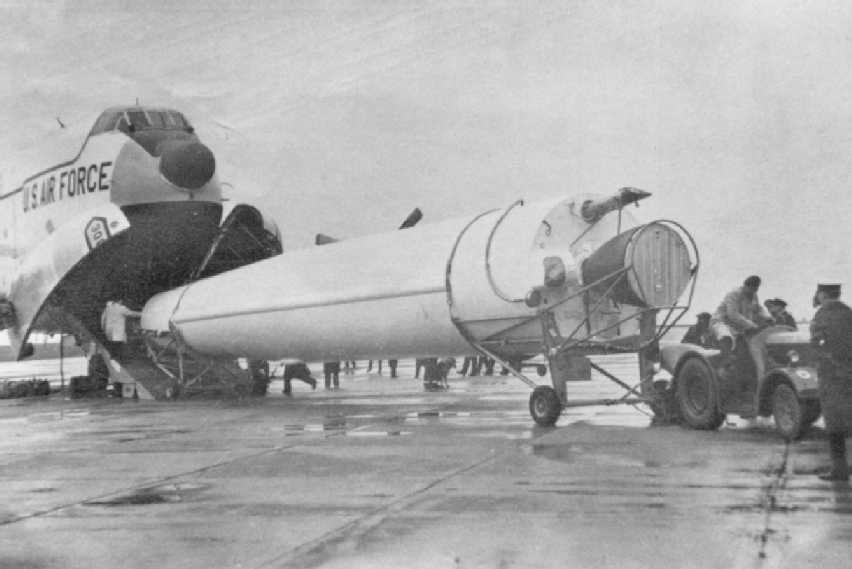
On 19 September 1958, 77(SM) Squadron received its first Thor missile, which was flown to RAF Lakenheath aboard a USAF C-124 Globemaster. All missiles and ground support equipment were delivered by air to the appropriate airhead (delivery airfield) for the particular complex.
The missile was still being operationally proven as a weapon system however, and it was not until 22 July 1959 that the next eight RAF squadrons were declared operational with the Thor. These were 82(SM) at Shepherd’s Grove and107(SM) at Tuddenham, both in Suffolk, 104(SM) at Ludford Magna, 106(SM) at Bardney, 142(SM) at Coleby Grange and 269(SM) at Caistor, all in Lincolnshire, 113(SM) at Mepal, Cambridgeshire, and 220(SM) at North Pickenham in Norfolk.
Four more Thor squadrons became operational on 1 August 1959, all of them in the East Riding of Yorkshire: 102(SM) at Full Sutton,150(SM) at Carnaby, 226(SM) at Catfoss and 240(SM) at Breighton.
On 01 December 1959, the seven remaining squadrons achieved operational status. 97(SM) at Hemswell, Lincolnshire, 98(SM) at Driffield Yorkshire, 144(SM) at North Luffenham, Rutland, 218(SM) at Harrington and 130(SM) at Polebrook, both in Northamptonshire, 254(SM) at Melton Mowbray, Leicestershire and 223(SM) at Folkingham, Lincolnshire.
A squadron Launch crew comprised a Launch Control Officer (LCO), usually a RAF Flight Lieutenant of the General Duties Branch, a Launch Control Console Operator (LCCO), usually Master Aircrew (equivalent rank to Warrant Officer), plus ground crew technicians of the relevant trades. The launch crew also included a USAF Authentication Officer (AO).
The operational control of Thor, covered by the understanding between the British and US Governments, was achieved via a ‘dual key’ system, whereby the RAF could initiate the countdown, but this would not progress to the actual launch until after the USAF AO had turned his key to arm the warhead. This arrangement satisfied both the political issues in the United Kingdom and the provisions of the McMahon act in the United States.
A launch order would come to the RAF launch crew from the Prime Minister, via a coded message from Bomber Command at High Wycombe. The USAF Authentication Officer would receive a separate but similarly coded launch order from the President of the United States via the 7th. Air Division, also at High Wycombe
BUILDING THE BASES
This task was a major undertaking. It was not made any easier due to the fact that the missile system was still, largely, under development and changes at this stage did occur, which, on occasion, called for modifications to work already in progress. Any such changes were rapidly communicated to other sites which may not have been quite so far advanced in their construction.
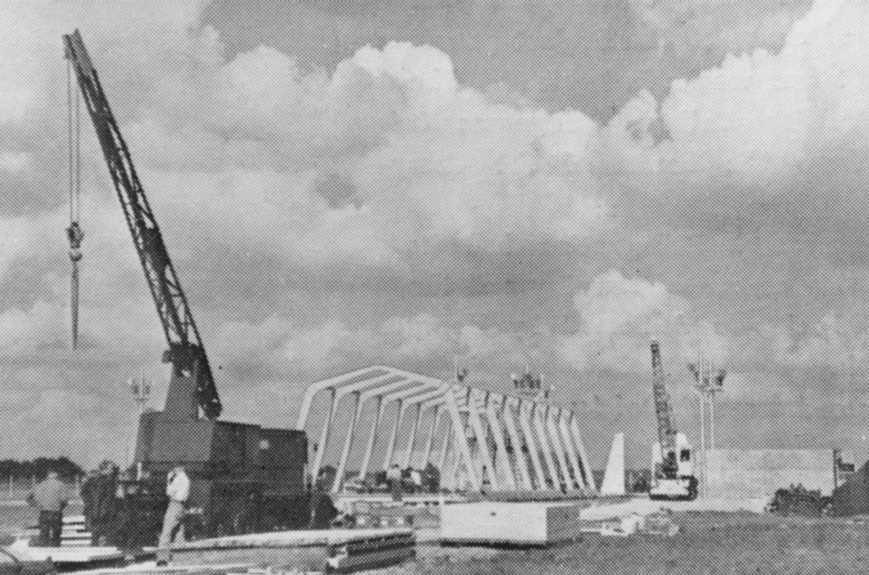
Before construction of the launch sites could begin, each of the chosen sites were subjected to detailed astro-geodetic surveys from both within the launch site area and from outside.
The British Director of Military Surveys was responsible for the survey works outside the sites, whilst the Americans, of the 1381st Geodetic Survey Squadron (Missile), of Orlando Air Force Base, Florida, completed the process inside the Feltwell and Hemswell complexes, that at the Driffield and North Luffenham complexes being handed over to the Air Ministry Works Directorate.
The ground was broken to begin works for the first complex at Feltwell on 12 May 1958, with that at the Hemswell, Driffield and North Luffenham complexes beginning on 17 July 1958, 22 December 1958 and 16 April 1959 respectively.
During the works, the four complexes required the excavation of some 600,000 cubic yards (458,733 cubic. metres) of material and the provision of 400,000 cubic yards (305,822 cubic metres) of selected fill, 80,000 cubic yards (61,164 cubic metres) of base concrete, 60,000 cubic yards (45,873 cubic metres) of vibrated concrete and 90,000 cubic yards (68,810 cubic metres) of high-quality concrete along with 36,000 feet (10,973 metres) of steel rails. Some sites, due to their geology, required piling in order to provide deep foundations that would ensure stability and the maintenance of the exacting level tolerances to which the launch emplacements were constructed. To this end, some 490 piles were used.
The Feltwell complex was completed by December 1958, followed by Hemswell on 30 April 1959, Driffield on 29 September 1959 and North Luffenham on 28 January 1960.
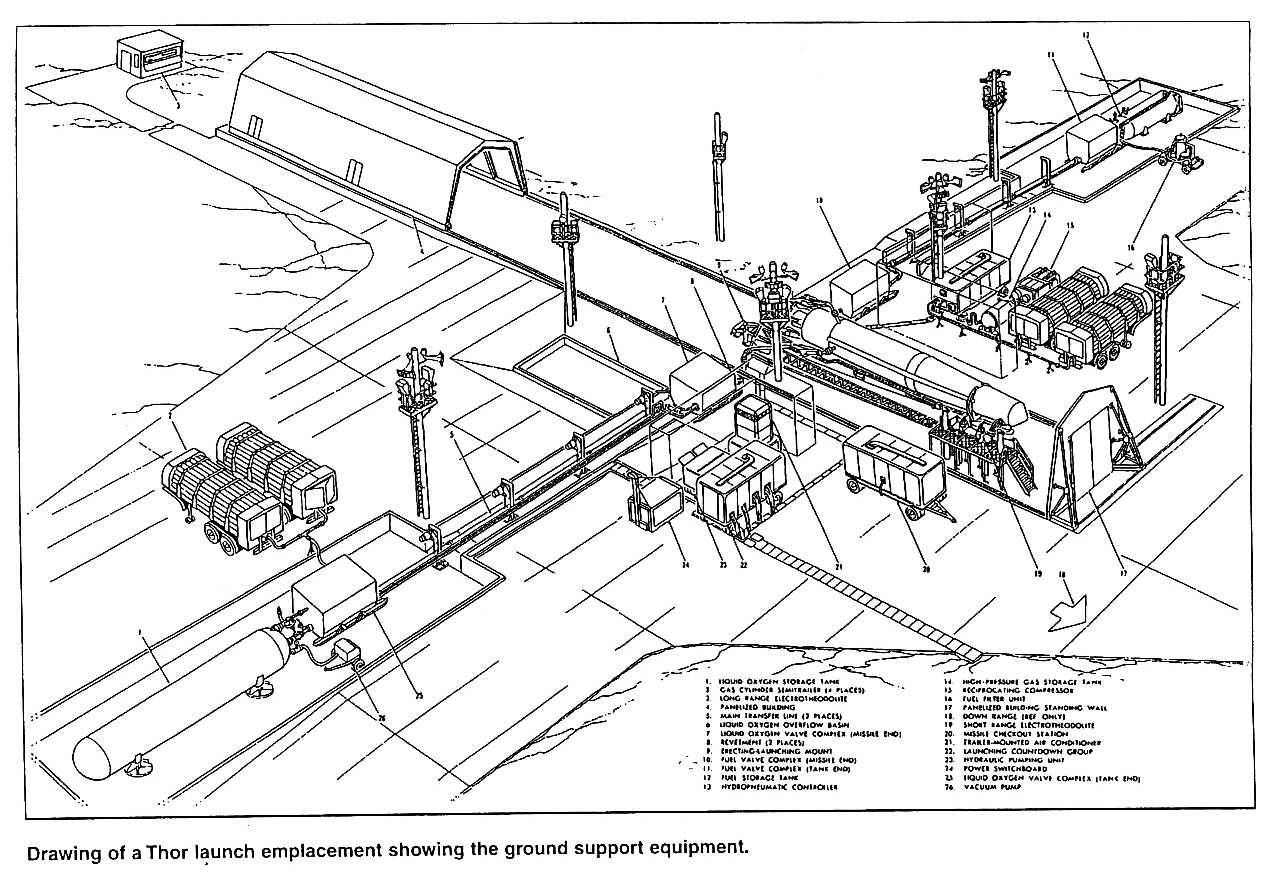
The works carried out at each launch site included the provision of water and electrical power by the utility providers, and communications, which, apart from radio links, were provided by GPO telephones. The major structures of the sites were the Launch Emplacements, Launch Control Area, a ‘single bay’ Classified Storage Building, Pyro Store, Mechanical and Electrical Plant Building, Fire tender Garage and the site roads. As much use as possible was made of any existing runways and perimeter tracks to give vehicular access to the launch emplacements and as Thor was an interim measure, it was only necessary to lay a fresh ribbon of tarmac on the second world war concrete to facilitate the smooth passage of vehicles. There were many criteria to adhere to in the placing of the major features of the site, mainly for safety reasons. Some were, however, more of a practical nature. Turning circles on site, for example, were to have a minimum radius of 50 feet (15 metres) and a very important issue was that the length of cabling required between the launch emplacement and the Launch Control trailer should not exceed 1,500 feet (457 metres). This is because the Thor equipment came from Douglas as identical kits and whilst it is easy to ‘lose’ some of the length of a cable run by the routing chosen, it was not possible to increase it.
The site perimeter was secured by a chain-link, or diamond-mesh, fence woven from vertical steel wires bent into a zigzag pattern such that each wire links with similar neighbouring wires to form a continuous width of fence possessing the diamond shaped pattern after which it is named. Concrete posts, spaced at approximately 8-foot (2.5 metres) intervals provided support for the fence and were topped with three strands of barbed wire.
Most of the equipment associated directly with the operation of the missile was trailer mounted and positioned at pre-determined points on the Launch Emplacement or Launch Control Area (LCA). Other buildings on the site, such as the squadron headquarters building, the off-site vehicle shelter and the crew chief and technical storage hut were all of temporary Type B hutting construction, whilst the LCT Annexe was a Terrapin type building. This annexe to the Launch Control Trailer was a local modification and provided an office and rest room for the launch crew and USAF AO.
As Thor was American built, its power sources needed to be at 60 Hertz (Hz), not the 50 Hz that most other countries, including the UK use. To that end, the mechanical and electrical plant building housed, in addition to a standby generator, motor-generators that would convert the incoming UK utility power to 480 volts at 60 Hz. for distribution to the site.
The main bases also required the conversion of two hangars, one of 45,000 square feet, as a Receipt, Inspection and Maintenance (RIM) building. The large hangar doors were permanently closed and smaller doors, large enough to allow the passage of a missile on its transporter / erector, were provided. Full air conditioning was installed, along with dust-proof floors, critical for guidance components. Internal partitions were erected to separate the building into individual areas. Various power and air supplies allowed testing of all missile components. Overhead cranes were also provided. The other hangar was utilised for technical storage.
The Classified Storage Building at a main base launch site also differed slightly in that it had a two-bay building as opposed to the single bay provided at the satellite sites. This building, along with the Pyro Store, were enclosed by a separate fenced-off area within the launch site. The area also included another, larger, single storey flat-roofed structure, the Surveillance and Inspection Building (S&I). This is where warheads could be inspected and stored.

LOGISTICS
The missiles and ground support equipment were delivered to the United Kingdom by Douglas C-124 Globemaster II and C-133 aircraft of the U.S. Military Air Transport Service.
All spare parts for the Thor missile system were supplied from the United-States. This was coordinated through the San Bernardino Air Materiel Area at Norton AFB in California. The issue and consumption of spares was recorded and a computer system automatically ordered re-supply.
In the case of an urgent demand for spares, caused by unforeseen circumstances, these were despatched from the USA by the first available air transport, Civil or Military. In urgent cases, delivery to site from the USA was within 50 hours.
TRAINING
The Royal Air Force launch crews were trained at the Douglas Aircraft Company school at Tucson, Arizona. Training comprised missile theory, construction and operation, and an introduction to the necessary ground support equipment. A simulator was used for instruction in countdown sequences, and malfunctions could be incorporated for emergency training.
On graduating from Tucson the crews moved to the home of the USAF’s 1st Missile Division at Vandenburg AFB, California, where more detailed training using operational equipment was conducted by the 392nd Missile Training Squadron, assisted by instructors from the Douglas Aircraft Company. A large proportion of the technicians in the force were NCOs of some considerable experience. These men were specially chosen for their ability and made an extremely favourable impression on the USAF during their period of training.
Because of the rate at which the Thor programme was introduced, training for the squadrons for the first two bases, while being adequate for the introduction of the system into the RAF, was not complete. While these squadrons were being trained, it should be noted, the Thor missile was still under development. The training for these squadrons was completed in the UK by American Field Training Detachments thus supplementing their initial training and bringing them up to date on missile development.
The training for the remainder of the force took place in the United States and was made under an Integrated Weapons System Training Plan, culminating in actual firings from Vandenberg Air Force Base, California. This training was completed during January of 1960, but continuation training would be an integral part of Thor operations in the United Kingdom.
The first RAF launch, codenamed ‘Lion’s Roar’, was made on 16 April 1959 and conducted by personnel from 98(SM) Squadron at RAF Driffield. The Launch Control Officer for this launch was the squadron’s CO, Squadron Leader P. G. Coulson, MBE DFC.
Some 50 RAF NCOs underwent further training in the United States to qualify them as instructors; they would then supervise the UK continuation training. They were also responsible for the future ab-initio training of replacement personnel during the life of the Thor weapon system.
In addition, launch crews and technical personnel were periodically returned to Vandenberg, along with a missile that had been stationed in the UK. These missiles were launched as part of a Combat Training Launch (CTL) programme. The main object of this programme was to demonstrate the effectiveness of the missiles and the launch crews and to evaluate how well the missiles were coping with the British Weather. The CTLs were also an opportunity to further refine and, if possible, shorten the count-down sequence.
RAF crews conducted twelve such CTLs, of which eleven were successful. The failed launch was CTL 11, codenamed ‘Black Knife’. It was a missile taken back from 102(SM) Sqn at Full Sutton, part of the Driffield Thor Complex; it suffered a ‘pitch programme’ failure and was destroyed by the Range Safety Officer at T (time of Launch) + 26 seconds.
Sequence Of Thor Launch


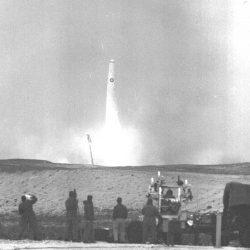

RESEARCH AND DEVELOPMENT FLIGHTS
The prototype Thor was launched at Cape Canaveral on 25 January 1957 from Pad LC-17B. The missile was Thor T101 (USAF serial 56-6751), a Series 1 research and development missile, although, because of the system of concurrency under which Thor was being developed, this was very close to being a production missile. This version was radio-guided. Combat configured Thors, as based in the UK, would be fitted with pure inertial guidance. The launch was unsuccessful as the missile rose only about six inches before falling back onto the pad and exploding. Contaminated Liquid Oxygen, causing the failure of a check valve, lead to thrust decay and the missile simply fell backwards. The next missile, T102 (56-6752) on 20 April, was destroyed by the Range Safety Officer (RSO) after 35 seconds of flight. This was a problem, not with the missile, but in the range instrumentation at Cape Canaveral. It showed the missile heading inland, rather than out to sea, because the wiring in a console was reversed. The RSO was in a blockhouse and could not see the missile, therefore, he had to believe his instrumentation. Eyewitnesses, watching the missile from outside, confirmed that the missile was heading out over the ocean when it was destroyed. The next two launches also resulted in failure, for different reasons but on September 20, 1957, Thor T105 (56-6755), which was still radio guided, successfully accomplished a 1,300-nautical mile flight and provided excellent telemetry results. Thor 113 (56-6784), the first to fly with the AC Spark Plug AChiever inertial guidance system, made a fully successful flight.
Thor made total of 17 Research and Development flights. Of these, 3 Malfunctioned, 8 were deemed as Partial Successes while 6 were Successful.
TECHNICAL DATA
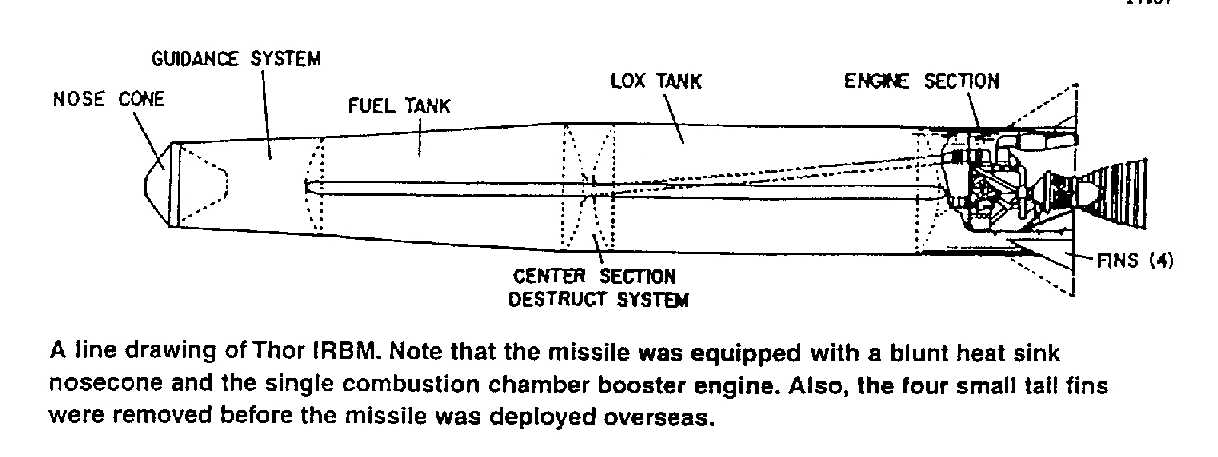
Thor was designed to reach targets up to a range of 1,500 nautical miles (1,727 statute miles). The combat configured missile was 63 ft 7.5 ins. long and 8 ft. in diameter where it was cylindrical. Mass, at launch, was 110,000 lb. Of this, some 98,000 lb. was accounted for by the propellants. The missile airframe was, therefore, a relatively light structure. Missiles in combat configuration did not carry the centre section destruct system shown in the drawing above.
Propulsion was via a single Rocketdyne LR-79-NA-9 liquid propellant rocket engine, which used RP-1 (a highly refined Kerosene) as fuel and Liquid Oxygen as the oxidiser. The engine produced a nominal sea-level thrust of 150,000 lb. To provide roll control and fine adjustment of the trajectory, two small Rocketdyne LR-101 vernier engines, each of 1000 pounds thrust, were fitted diametrically opposed at the base of the missile. Together, the LR79 main engine and LR-101 vernier engines made up the Rocketdyne MB-3, which is the normal nomenclature for the Thor propulsion group.
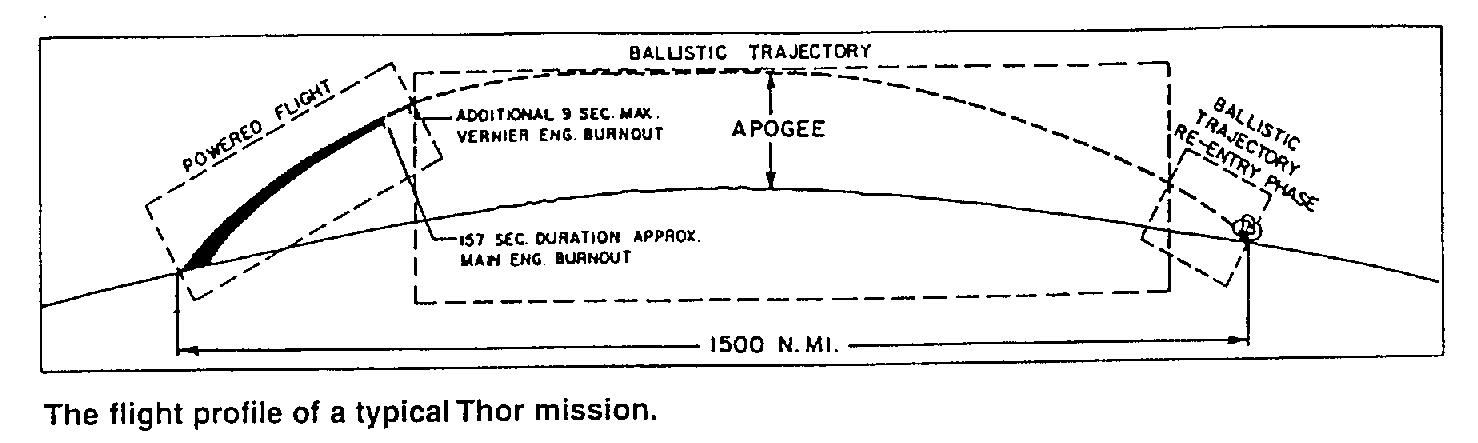
For the first 108 seconds of flight, the automatic pilot in the missile responded to instructions provided by a punched film strip which ran at a precise rate. At 108.5 seconds, the AC Spark Plug inertial guidance system, which had been monitoring the missile’s progress since lift-off, took over and made the final corrections to the trajectory. The guidance system also provided the Main Engine Cut Off (MECO) and Vernier Engine Cut Off (VECO) signals at the appropriate velocities and sent the final warhead arming signal. VECO was generally in the region of 160 seconds after launch.
The re-entry vehicle, containing the warhead, was then separated from the main body of the missile by the operation of explosive bolts and the firing of retro rockets which retarded the missile fuselage. The fuselage fell back into the atmosphere and burned up, whilst the re-entry vehicle continued, alone and unguided, to the target.
The missile was normally kept horizontal inside its shelter which provided protection from the elements. It was essential that the gyros in the inertial guidance system were maintained at a precise temperature to ensure their accuracy; the electrical supplies for this were continuously monitored in a practice that became known as ‘bird watching’.
When The RAF Launch Control Officer turned his launch sequence key to ‘START’ the countdown was initiated, and an automatic five-phase sequence of events followed.
Phase 1: All equipment and targeting data checked. Guidance aligned.
Phase 2: Engine slew. Shelter retracted and missile erected.
Phase 3: Missile loaded with RP-1* and Liquid Oxygen. The transporter / erector was then lowered.
Phase 4: Missile functions transferred to internal power. Engine slew on internal power. Target selection checked. Authentication Officer’s key turned from ‘Peace’ to ‘War’.
Phase 5: Liquid Oxygen topped up. LOX Valve position check. Tanks pressurised. Engines started. Missile lift-off. .
*Although missiles were regularly filled with Liquid Oxygen, the RP-1 fuel could not be loaded into the missile unless a live launch was imminent. This was due to the fuel being corrosive and no facilities existed in the UK for cleaning the fuel tank of residual RP-1. During exercises requiring the flow of RP-1, the fuel was diverted into a mobile tanker brought onto the launch emplacement especially for that purpose.
During the launch countdown a hold, which could be introduced at the end of Phase 2, would leave the missile just over 6 minutes from lift-off. (Using countdown average timings). A technique could also be employed which would hold the countdown at the end of Phase 3, when the missile, again on average countdown timings, would be just under 3 minutes from launch. The length of this hold, however, with LOX in the missile, was severely restricted and affected by various factors, the actual available hold period being calculated at the time.
Liquid fuelled rocket engines were generally a disadvantage when used for military operations. Whilst these engines have better performance and control, the missile needs to be fuelled just prior to launch, increasing the countdown time. The propellants can be dangerous to handle.

END OF THE UK THOR DEPLOYMENT
The Thor deployment in the United Kingdom was always planned as an interim measure; for America, it was intended to fill the perceived missile ‘gap’ until the first Intercontinental Ballistic Missiles (Atlas, Titan) were deployed on US soil. To the British, it became seen as a route to having ballistic missiles some years earlier than the indigenous Blue Streak could be deployed. In the event, Blue Streak was cancelled in 1960. US Secretary of Defense, Robert S. McNamara informed the British Minister of Defence that the US would not support Thor operations after 31 October 1964. The British Government, however, stood down the Thor squadrons in the summer of 1963, thus bringing to an end the only period that the RAF would ever operate such a weapon; it had, indeed, been a unique period in the history of the Royal Air Force.
As Thor’s UK vigil drew to a close, the RAF’s V-Class bombers were being armed with the British designed Blue Steel stand-off missile.
The Thor missiles were airlifted back to the USA; most being used as space launch vehicles. Some Thors continued in service with the USAF’s Program 437 on Johnston Island in the Pacific until 1975.
COMMAND STRUCTURE
RAF Harrington came under 3 Group, Bomber Command and was parented by RAF North Luffenham. The senior officers during the Thor era are shown below.
Air Officers Commanding – in – Chief Bomber Command
Air Marshal (later ACM) Sir Harry Broadhurst KCB CBE DSO DFC AFC – 22 Jan 1956
Air Marshal Sir Kenneth Cross KCB CBE DSO DFC – 20 May 1959
Air Officers Commanding – 3 Group Bomber Command
Air Vice Marshal K B B Cross CB CBE DSO DFC – 02 Feb 1956
Air Vice Marshal M H Dwyer CBE – 04 May 1959
Air Vice Marshal B K Burnett CB DFC – 09 Oct 1961
Station Commanders – RAF North Luffenham
Group Captain P R W Sands MBE DFC. 09 Sep 1959 – Jan 1961
Group Captain J A Sowrey DFC AFC. Jan 1961 – Aug 1963
Commanding Officers – 218(SM) Squadron RAF Harrington
Squadron Leader J C Burch Dec. 1959 – Dec 1961
Squadron Leader F W Slaughter. Dec 1961 – Aug 1963
Bibliography.
Thor: Anatomy of a Weapon System.
Geoff Goodchild
Fonthill Media
The Development of Ballistic Missiles in the United States Air Force 1945 – 1960
Jacob Neufeld
University Press of the Pacific
RAF Nuclear Deterrent Forces
Humphrey Wynn
The Stationery Office